
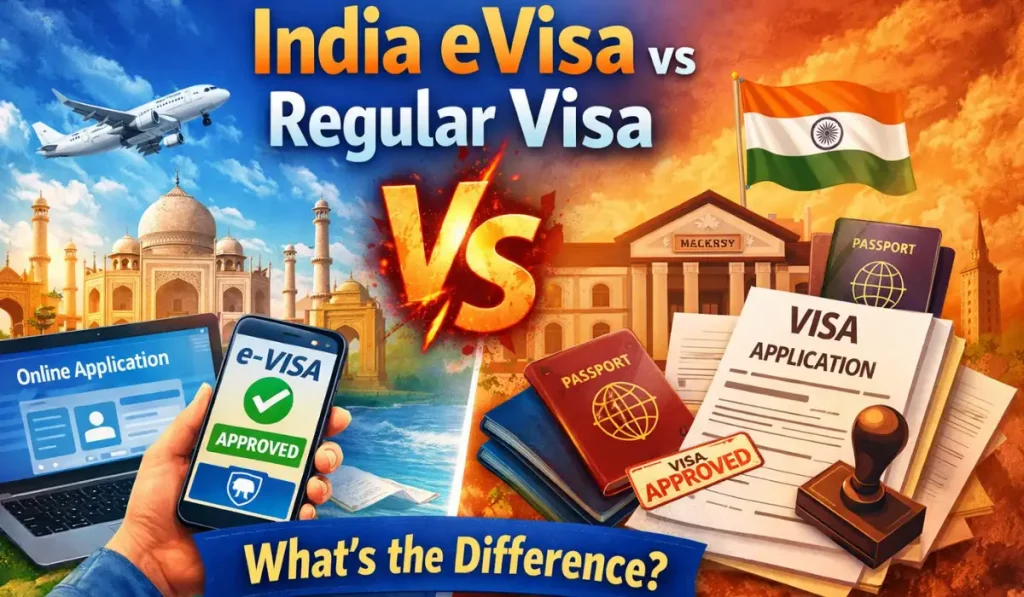
If you are planning a trip to India, one of the first things you need to decide is which visa to apply for. Many travelers feel confused when they see two common options: eVisa and Regular Visa. This confusion is very normal, especially if you are applying for an Indian visa for the first time.
This detailed guide on India eVisa vs Regular Visa is written to clear all your doubts. I will explain everything in very simple English so that anyone can understand it easily. By the end of this article, you will clearly know the difference between India eVisa vs Regular Visa, which one is better for your travel plans, and how to choose the right option without stress.
Why People Get Confused Between India eVisa vs Regular Visa
Most travelers only know that they need a visa to enter India. When they start searching online, they suddenly see two options: India eVisa and Regular Visa. Both are official and both allow entry into India, but they work in very different ways.
The confusion happens because people do not understand the purpose, duration, and process of each visa. That is why comparing India eVisa vs Regular Visa in detail is very important before applying.
What Is an India eVisa?
An India eVisa is an electronic visa that you can apply for completely online. You do not need to visit an Indian embassy or submit your passport physically. The entire process is digital and approved by India.
Once your application is approved, you receive the visa by email. You can print it or keep it on your phone and show it at the airport when you arrive in India.
When people talk about India eVisa vs Regular Visa, the eVisa is usually known for being fast, easy, and convenient.
Who Should Apply for an India eVisa?
India eVisa is best for:
- Tourists coming for sightseeing or holidays
- Business travelers attending meetings or events
- Medical travelers coming for treatment
- Short-term visits
If your travel plan is simple and short, the India eVisa vs Regular Visa comparison often favors the eVisa.
What Is a Regular Visa?
A Regular Visa is the traditional type of visa that has been used for many years. This visa requires more paperwork and usually involves visiting an embassy or a visa application center.
Your passport is physically stamped with the visa. This type of visa is more suitable for people who want to stay in India for a longer period or have special purposes like work or study.
When comparing India eVisa vs Regular Visa, the Regular Visa is known for flexibility and longer validity.
Who Should Apply for a Regular Visa?
A Regular Visa is suitable for:
- Students
- Employees or professionals
- Long-term visitors
- People planning to stay in India for months or years
Application Process: India eVisa vs Regular Visa
This is one of the biggest differences between India eVisa vs Regular Visa.
India eVisa Application Process
The eVisa process is very simple:
- Apply online from anywhere
- Upload your documents digitally
- Pay the fee online
- Receive approval by email
Many travelers use trusted India Online Visa services to avoid mistakes and save time.
Regular Visa Application Process
The Regular Visa process is more complex:
- Fill out forms online or offline
- Visit an embassy or visa center
- Submit original passport
- Provide extra documents
- Wait for approval
Because of this difference, most short-term travelers prefer eVisa when comparing India eVisa vs Regular Visa.
Processing Time: Which One Is Faster?
Processing time is very important, especially if your travel date is close.
- India eVisa: Usually approved within 2 to 5 working days
- Regular Visa: Can take 2 to 4 weeks or sometimes longer
This speed difference plays a major role in the India eVisa vs Regular Visa decision.
Validity and Length of Stay
Another important point in India eVisa vs Regular Visa is how long you can stay in India.
India eVisa
- Valid for short stays
- Options like 30 days, 1 year, or 5 years
- Limited stay duration per visit
Regular Visa
- Valid for long-term stays
- Can be issued for several months or years
- Better for people who need flexibility
If you are planning a long stay, the India eVisa vs Regular Visa comparison usually favors the Regular Visa.
Entry Rules and Travel Flexibility
India eVisa holders can enter India only through specific international airports and seaports. This is a limitation that many travelers do not notice at first.
Regular Visa holders can enter through almost any authorized entry point in India. This difference is very important when comparing India eVisa vs Regular Visa, especially for frequent travelers.
Cost Difference: India eVisa vs Regular Visa
Visa cost is another factor people consider.
- India eVisa: Usually cheaper and has fewer service charges
- Regular Visa: More expensive due to processing and service fees
For budget travelers, the India eVisa vs Regular Visa comparison often shows that eVisa is more affordable.
Documents Required
Documents for India eVisa
- Passport scan
- Recent photo
- Basic travel details
Documents for Regular Visa
- Original passport
- Photos
- Address proof
- Financial documents
- Invitation letters (if needed)
The document difference clearly explains why many people choose eVisa when thinking about India eVisa vs Regular Visa.
Extension and Conversion Rules
India eVisa usually cannot be extended or converted into another visa type. Once it expires, you must leave India.
Regular Visas may allow extension or conversion in special cases. This is a major advantage in the India eVisa vs Regular Visa comparison for long-term travelers.
Safety and Legality
Both India eVisa and Regular Visa are legal and safe because they are issued by India. The difference is not about safety, but about purpose and duration.
Using a reliable India Online Visa service can help ensure that your application is correct and approved smoothly.
Final Thoughts on India eVisa vs Regular Visa
To summarize, choosing between India eVisa vs Regular Visa depends on your travel needs.
Choose India eVisa if:
- Your trip is short
- You want fast approval
- You prefer an online process
Choose Regular Visa if:
- You plan a long stay
- You need work or study permission
- You want flexible entry options
Understanding India eVisa vs Regular Visa makes your travel planning easier and stress-free. With the right choice, your journey to India can begin smoothly and confidently.